Inside Ceramic: Purity Shapes Performance
If you ask engineers working with technical ceramics what properties matter most, the conversation usually starts with hardness, thermal stability, dielectric performance, or purity. Flexural strength often appears later in the discussion, even though it is frequently one of the properties most closely tied to how a ceramic component performs in service as ceramics rarely operate under ideal loading conditions.
A ceramic component inside a semiconductor tool, medical device, or aerospace assembly is not sitting in a laboratory test environment experiencing only compressive force. It sees thermal gradients, local stress, handling loads, vibration, and often rapid process changes. Under those conditions, bending stresses become very real, and that is where flexural strength becomes important.
For high purity alumina ceramics, flexural strength provides insight into something larger than mechanical performance alone. It tells a story about the material itself, its purity, microstructure, processing route, and ultimately its reliability.
Looking Beyond Compressive Strength
One of the interesting characteristics of ceramics is that they perform exceptionally well in compression but much less favorably in tension. This is not new information to ceramic engineers, but it becomes important when thinking about flexural loading.
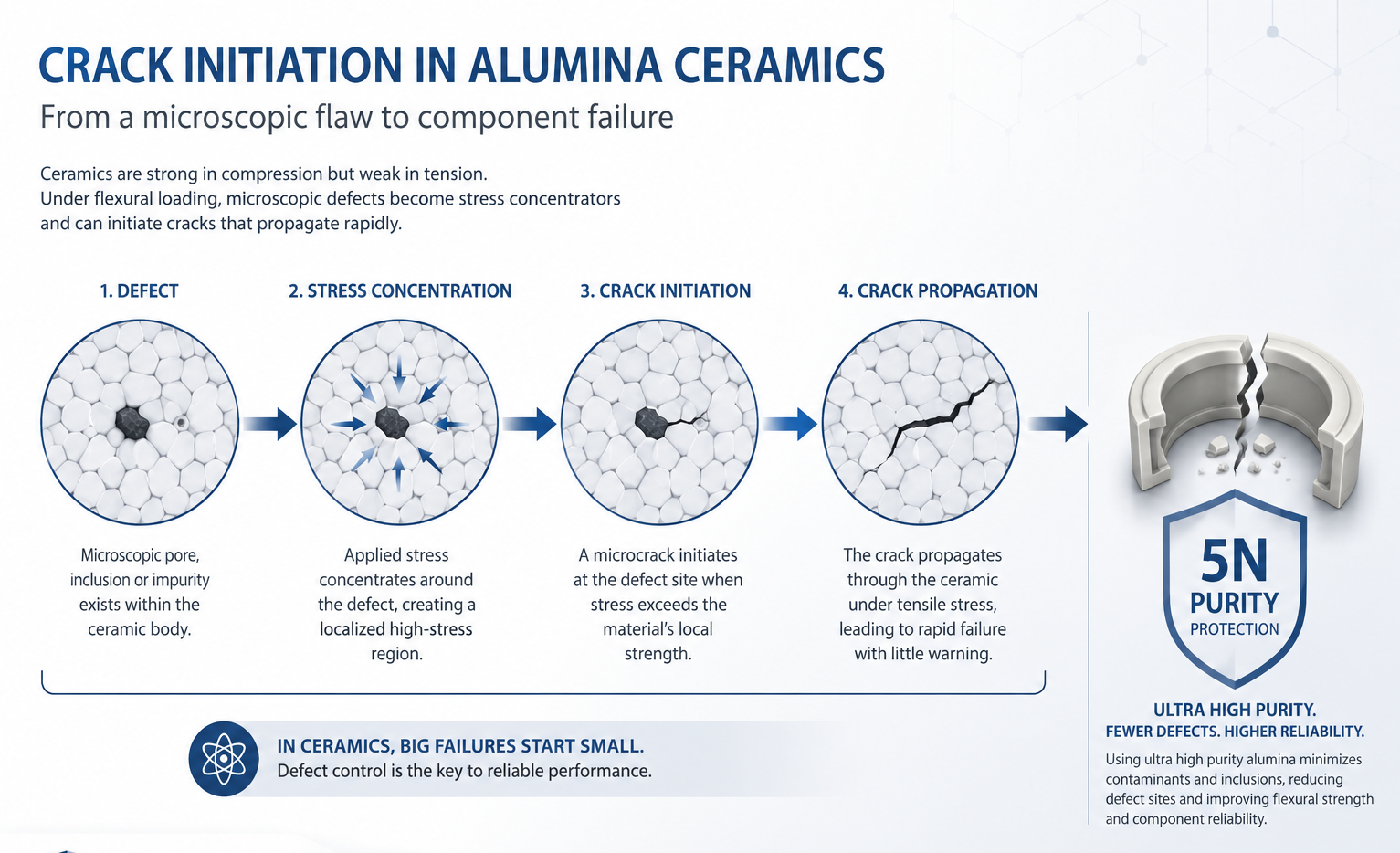
In a flexural test, one side of the sample experiences compression while the opposite side experiences tension. The tensile side often becomes the critical region because ceramics are inherently sensitive to flaws. Failure typically begins at a local defect and then propagates rapidly.
What makes this especially interesting is that the bulk material may still appear perfectly sound. The component does not fail because the entire ceramic body weakens uniformly. Instead, failure usually starts from something microscopic, a pore, an inclusion, an agglomerate, or a local impurity concentration.
That small imperfection becomes a stress concentrator. Once a crack initiates, ceramics offer little plastic deformation to absorb energy. The crack simply grows.
This is why flexural strength is often less about “strength” in the conventional sense and more about defect control.
Purity Plays a Bigger Role Than Many Assume
When discussing alumina ceramics, purity is often associated with electrical performance, contamination control, or thermal properties. Mechanical performance is not always the first topic.
Yet purity has a surprisingly direct influence on flexural behavior. Lower purity alumina’s can contain trace levels of sodium, silica, calcium, iron, or other residual species. Individually these concentrations may appear insignificant, but during sintering they can influence grain growth, densification behavior, and local microstructure formation.
The result may be subtle variations inside the ceramic body. These variations matter because ceramics respond strongly to local discontinuities.
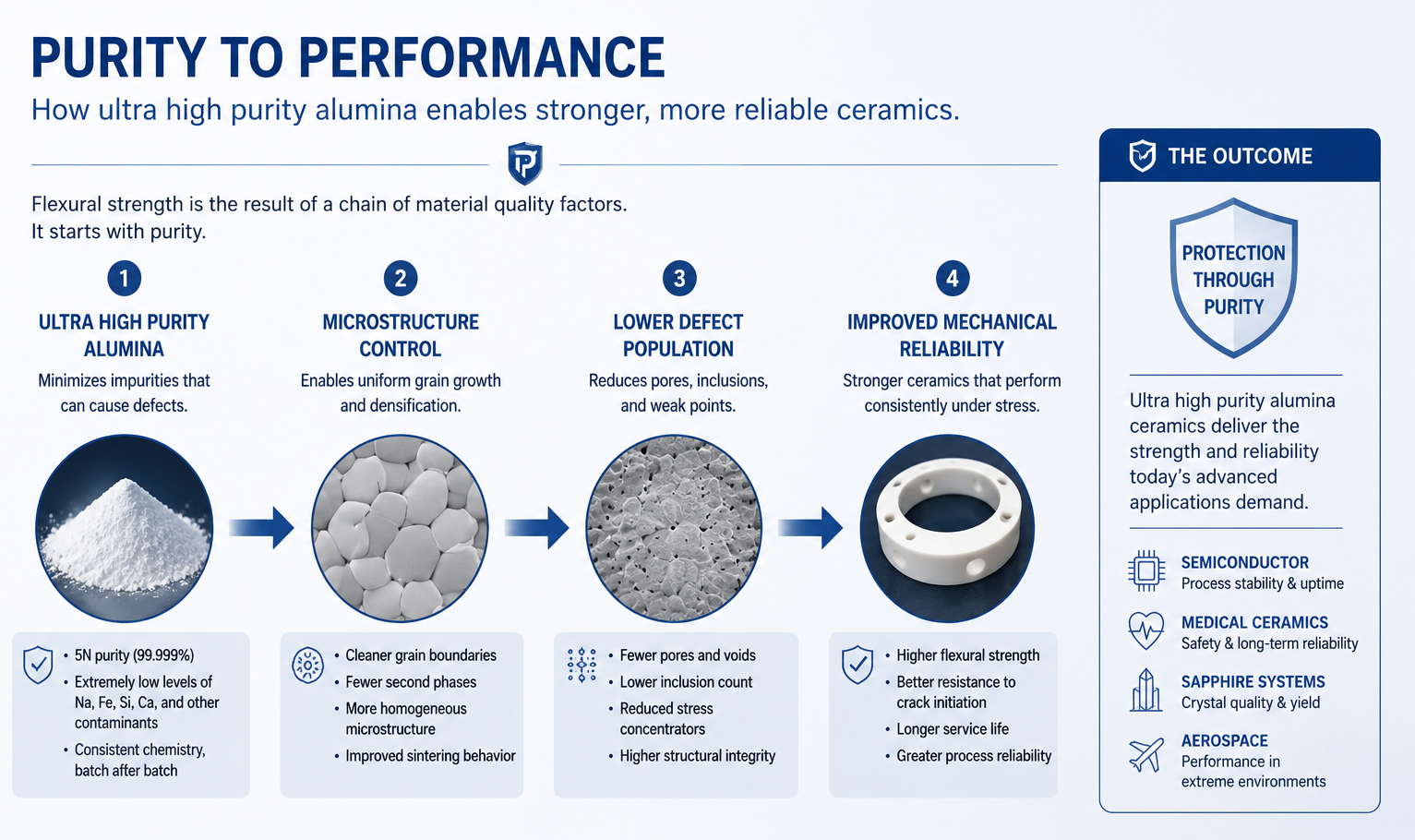
High purity alumina reduces many of these variables. Fewer contaminants generally mean fewer opportunities for unwanted phases, cleaner grain boundaries, and more consistent densification behavior.
At very high purity levels, such as 5N alumina, material consistency becomes an important enabler for mechanical reliability, especially in demanding applications. Polar’s manufacturing platform was developed specifically around ultra-high purity alumina production, reaching up to 99.999% purity while maintaining process consistency and lower environmental impact.
The connection between purity and flexural performance is therefore indirect but powerful: Purity influences microstructure, which influences defects, which influence flexural strength.
Density and Defect Population
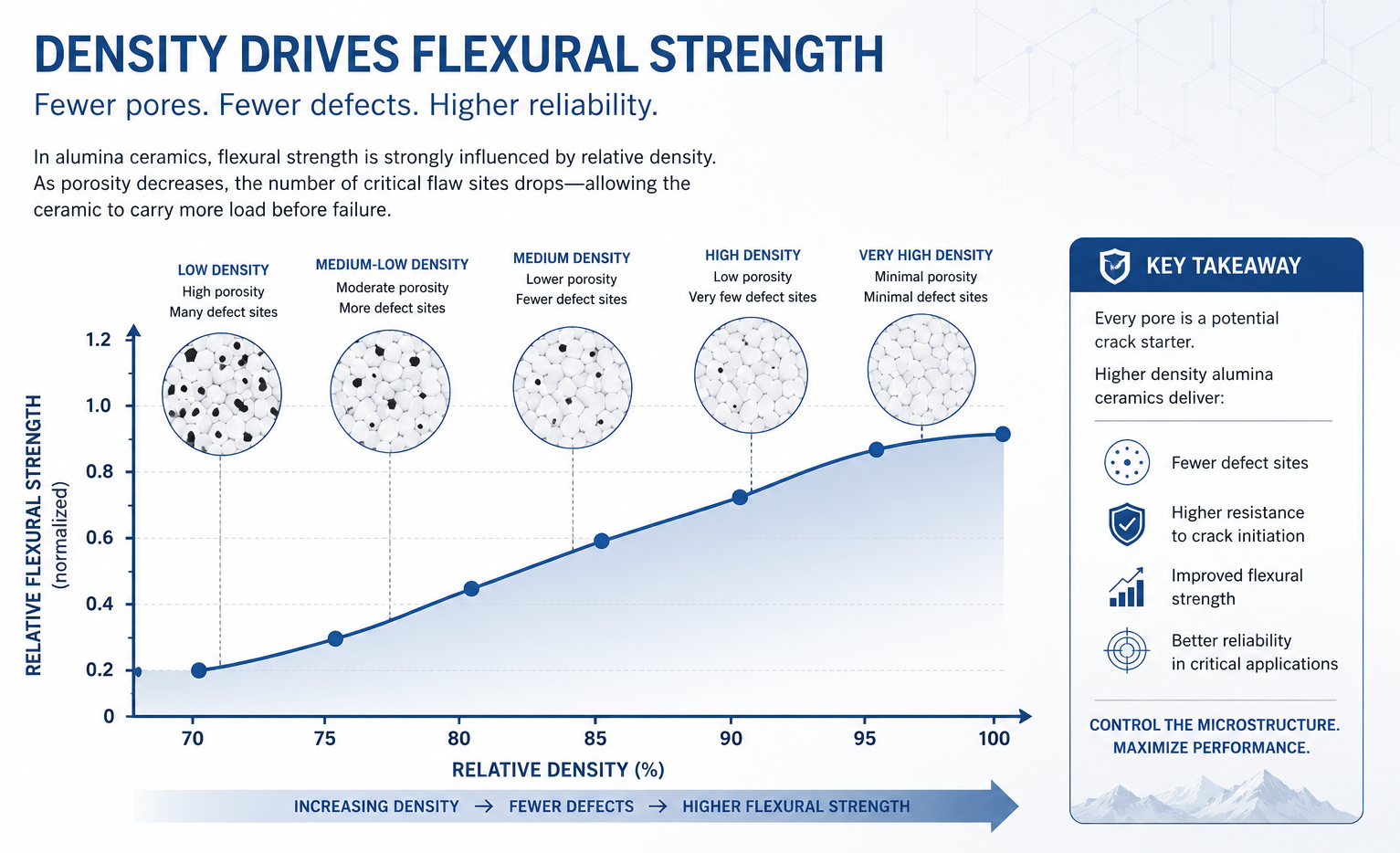
Most ceramic engineers intuitively understand the relationship between density and performance: As porosity decreases, strength generally improves. The reason comes back again to defects.
Every pore inside a ceramic body represents a potential stress concentration point. Under flexural loading those regions become preferred sites for crack initiation. A highly dense ceramic alumina effectively reduces the population of these initiation points.
This is one reason why powder quality matters so much. Particle morphology, particle size distribution, agglomeration behavior, and sintering response all contribute to final density. Two alumina powders with identical chemistry may still produce very different ceramic performance depending on how they are processed.
This is often where material selection becomes less straightforward than simply choosing a purity number from a specification sheet.
Why Semiconductor Applications Push the Discussion Further
The semiconductor industry has brought renewed attention to material purity and defect control.
Ceramic components inside semiconductor manufacturing tools operate in environments where contamination sensitivity continues to increase as device geometries shrink. Materials that were acceptable several process generations ago may no longer satisfy today’s requirements.
The industry trend toward higher purity materials reflects this reality. Semiconductor manufacturing increasingly relies on 4N and 5N material systems to reduce contamination risk and protect yield. Mechanical reliability has become part of that discussion.
A ceramic component that experiences microcracking or premature failure introduces more than replacement cost. It can affect uptime, maintenance intervals, and process stability. Flexural strength therefore becomes one indicator of overall material robustness.
Not because it predicts every failure mode, but because it reflects how successfully the material avoids defects.
The Same Principles Apply Outside Semiconductors
The relationship between purity, microstructure, and mechanical performance extends well beyond semiconductor applications.
Medical ceramics depend on long-term reliability and structural stability. Aerospace ceramic systems face thermal and mechanical extremes. Sapphire growth environments demand exceptionally stable alumina feedstocks and ceramic support components.
The applications differ, but the materials science remains remarkably similar. In each case, performance often depends on controlling the smallest details.
Flexural Strength as a Window Into Material Quality
One of the valuable aspects of flexural strength is that it encourages a broader view of ceramic performance. It reminds us that ceramic reliability is rarely determined by a single parameter.
Performance emerges from the combined influence of purity, processing, microstructure, and material consistency. Looking at flexural strength through this lens shifts the discussion from simply measuring performance to understanding how that performance is created.
For high purity alumina ceramics, this relationship becomes particularly important because small changes at the microscopic level can influence performance at the component level.
The discussion therefore moves beyond mechanical strength alone. It becomes a discussion about material quality, process consistency, and reliability.
For engineers developing technical ceramic systems, flexural strength can serve as a useful lens through which to evaluate these interactions. Not as a standalone metric, but as an indicator of how effectively the entire material system was designed and controlled.
Ultimately, technical ceramics succeed when they perform predictably and consistently under real operating conditions.
Flexural strength insights helps us understand why some materials do exactly that.