When engineers evaluate technical ceramics, the conversation almost always starts with composition. Purity levels, chemical resistance, and material grades tend to dominate the discussion.
But that is not where performance is truly decided.
The real story sits beneath the surface, at a scale most never see. It is the microstructure of the material that ultimately determines how a ceramic performs in the real world.
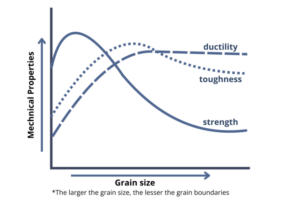
Microstructure describes how the material is organized at a microscopic level. It includes the size and distribution of grains, the nature of grain boundaries, and the presence of pores or impurities. While invisible to the naked eye, these features dictate how a ceramic behaves under stress, heat, and chemical exposure.
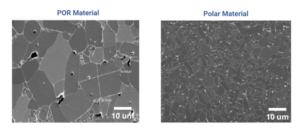
The difference between a material that performs reliably and one that fails prematurely is often found here.
Take grain structure as an example. A uniform and fine grain structure creates a dense, stable material with fewer internal weak points. In contrast, irregular grain growth introduces variability, and with it, risk. Cracks tend to initiate where the structure is inconsistent, especially under thermal or mechanical stress. What looks like a small variation under a microscope can translate into a significant performance issue in application.
This is where purity becomes critical, but not in the way it is often discussed.
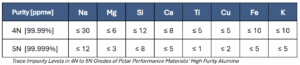
Purity is not simply a number on a datasheet. It is a driver of how the material behaves during processing, particularly during sintering. Even small amounts of impurities such as silica, sodium, or calcium can interfere with grain formation and disrupt the integrity of grain boundaries. Instead of a controlled, dense structure, the material develops irregular grains, increased porosity, and weak interfaces.
Over time, those weaknesses become failure points.
Ultra high purity alumina enables a fundamentally different outcome. With fewer contaminants present, grain growth can be tightly controlled, resulting in a dense and uniform microstructure. Grain boundaries are stronger, porosity is minimized, and the material behaves more predictably under demanding conditions.
This has a direct impact on mechanical performance. Ceramics are inherently brittle, so their strength depends on minimizing internal defects. A clean and consistent microstructure reduces the number of stress concentrators where cracks can form. The result is higher strength, better reliability, and longer service life.
The same principle applies to thermal performance.
Heat does not move through a ceramic in a vacuum. It is influenced by grain boundaries and disrupted by pores. A well-structured material allows for more stable thermal conductivity and improved resistance to thermal shock. In environments such as semiconductor processing, where temperature gradients are extreme and precision is non-negotiable, this level of control is essential.
Chemical resistance follows the same pattern. Dense, high purity alumina provides fewer pathways for aggressive species to penetrate the material. When impurities and porosity are present, they create entry points for chemical attack, gradually degrading the structure. Over time, this compromises both performance and reliability.
What becomes clear is that microstructure is not a secondary characteristic. It is the foundation of performance.
At Polar Performance, this understanding shapes how we approach ultra high purity alumina. Purity is not treated as a standalone specification. It is the starting point for achieving consistent and controlled microstructures that deliver reliable performance in the field.
Because in advanced applications, consistency is what matters most. Whether in semiconductor environments, precision engineering systems, or high temperature industrial processes, materials are expected to perform without deviation.
That expectation can only be met when the microstructure is right.
You can design the most advanced system, optimize every parameter, and refine every process. But if the material itself is inconsistent at the microscopic level, performance will always be at risk.
Microstructure is where that risk is removed.
For technical guidance on applying POLARGuard in your ceramic designs, reach out to explore how its high purity and tightly controlled microstructure translate into more reliable, higher-performing outcomes.